



Institutional ResearchNovember 2026

Understanding Onchain Vaults

Mechanics, Risks, and Opportunities

Commissioned bySteakhouse Financial
Data partnerToken Terminal

Onchain vaults have become one of the fastest-growing segments of onchain finance. This report explains how vaults work, where their risks sit, and where the model is heading.

* By submitting your email, you consent to receive research and marketing communications from Blockstories.See our privacy policy.

Cover of Understanding Onchain Vaults

With contributions from

  • Janus Henderson
  • Fasanara Capital
  • Qivalis
  • Morpho
  • Coinbase
  • Circle
  • Nexus Mutual
  • Aon

Voices from the report

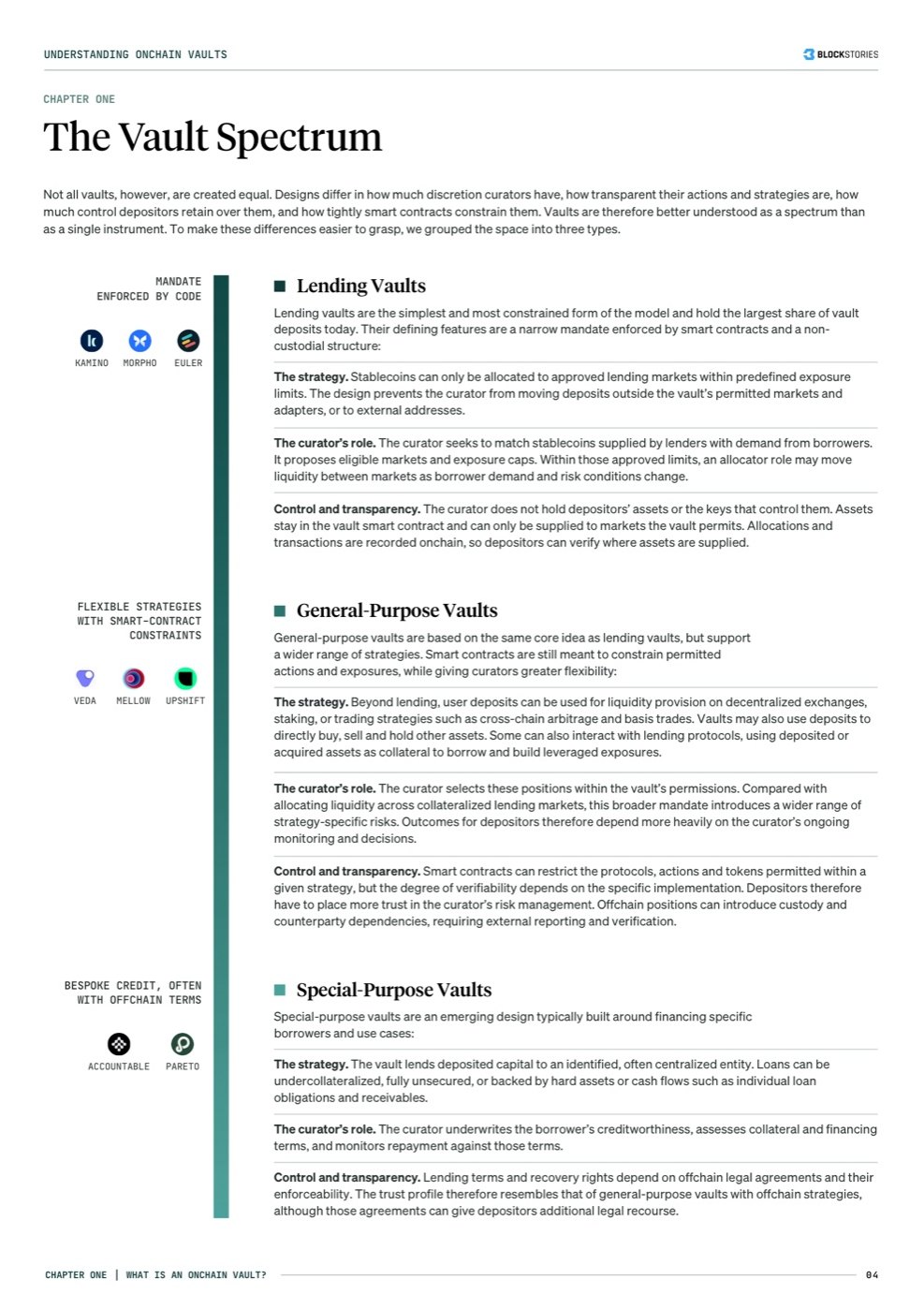
“The vault gives depositors exposure to a book of stablecoins and collateralized loans or repayment obligations, with allocations made within a smart-contract-enforced ruleset, so users do not need to select individual lending markets themselves.”

Adrian Cachinero Vasiljevic, Co-Founder, Steakhouse Financial

“The flywheel is straightforward: fintechs bring more stablecoin supply onchain, while tokenized assets create new borrowing demand. Higher utilization supports better yields for lenders, which attracts more capital and deepens liquidity. As the market grows, borrowers can access larger loans at more competitive rates, making onchain financing increasingly relevant for institutions.”

Merlin Egalite, Co-Founder, Morpho

“Looping and vault infrastructure can give tokenized assets more utility by solving real financing needs for investors. If that utility solves a meaningful investment problem, more investors will use the product and the market can scale.”

Nick Cherney, Head of Innovation, Janus Henderson

“We see great potential in vaults as a growth engine. One of the use cases some of our shareholder banks see is institutional vaults for onchain repo transactions, where they could manage collateral more efficiently and connect it with their own tokenized real-world assets.”

Ernesto Olmedo Pereira, Head of DeFi Partnerships & Strategy, Qivalis

“The key requirement to successful underwriting is independent verifiability. If we can confirm a vault's allocations onchain, do due diligence on every protocol and asset it touches, and the risk sits within our internal limits, we can cover it.”

Lee McClelland, Head of Risk, Nexus Mutual

“Large financial institutions already purchase substantial amounts of insurance across their traditional activities. As they increasingly allocate capital through vaults, demand for comparable protection could encourage their existing insurers to extend coverage to these exposures.”

Rupert Poland, Digital Asset Leader, Aon

The data

Today's vault market at a glance

Morpho accounts for roughly 58% of all vault deposits, making its data a useful proxy for the state of the broader vault ecosystem.

The charts below show how its deposits have grown, how much of the stablecoin supply now sits in vaults, and how large vaults have become within DeFi as a whole.

Deposits Across All Morpho Vaults
  • Stablecoins
  • Non-stablecoins

Data: Token Terminal · as of Nov 1, 2026

Market size

Morpho vaults now hold $6.8B in deposits

Deposits have grown from close to zero in January 2024 to $6.8B, up 26% over the past twelve months.

Stablecoins account for 96% of those deposits. Vaults have become the layer that puts idle dollar balances to work, routing them into isolated lending markets under rules enforced by smart contracts.

Stablecoin Supply Growth & Morpho Vault Penetration
  • Stablecoin supply
  • Share deposited in vaults

Data: Token Terminal · as of Nov 1, 2026

Stablecoins, the growth engine

2.1% of all stablecoins now sit in a Morpho vault

Stablecoin supply grew to $310B over the past year, and the share of it deposited in vaults rose from 1.3% to 2.1%.

Vault deposits are growing faster than the supply itself, as more of the dollars sitting in wallets, exchanges and fintech apps are put to work.

Morpho Vault Deposits as a Share of DeFi TVL

Data: Token Terminal · as of Nov 1, 2026

DeFi footprint

Vaults account for 5.7% of all value locked in DeFi

Up from 3.1% a year ago and close to zero at the start of 2024.

The comparison excludes stablecoin issuers, RWA issuers, liquid staking and asset managers.

The landscape

The vault ecosystem map

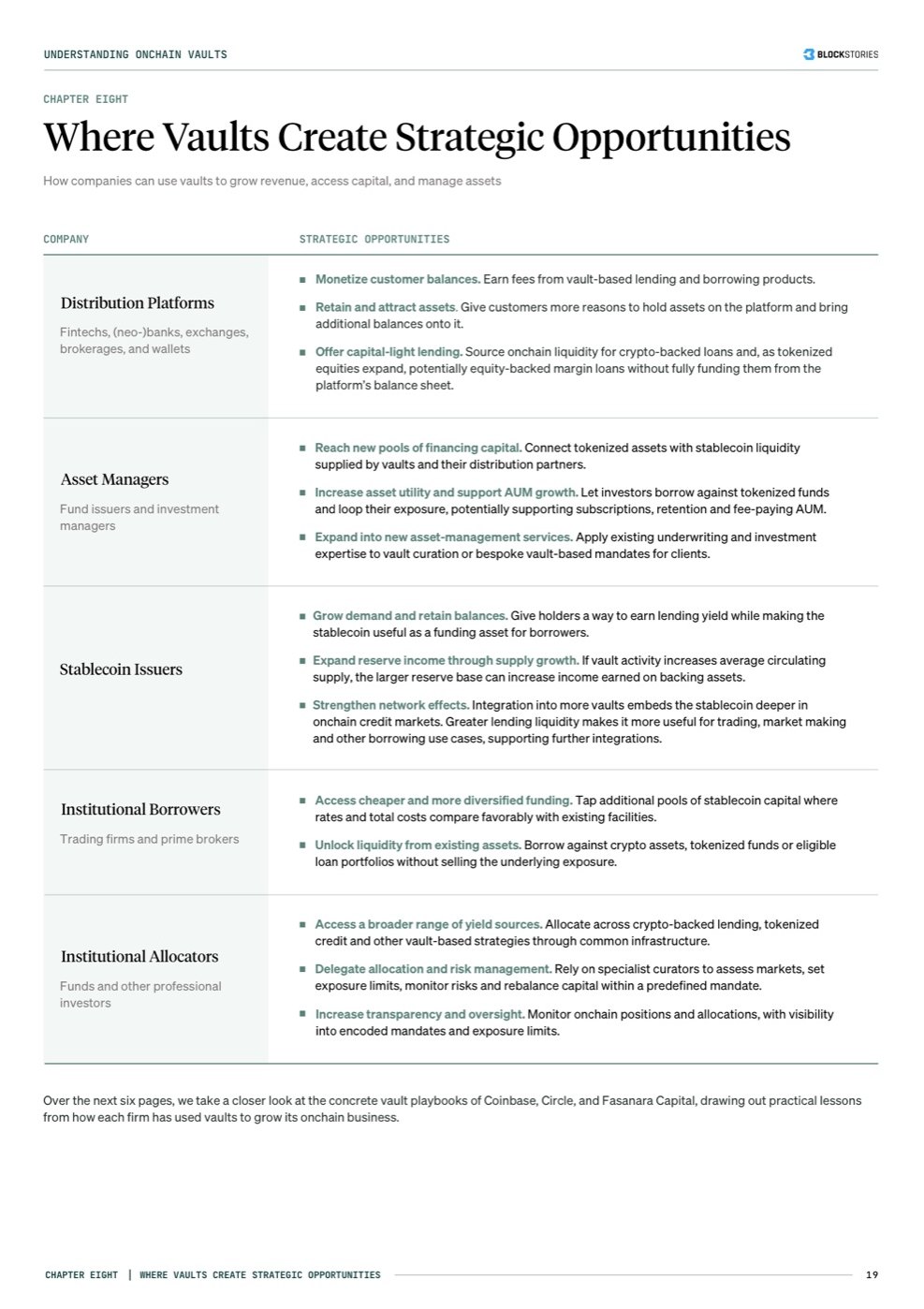
The vault market has grown into a value chain of its own: the infrastructure vaults are built on, the curators that manage their risk, the platforms that distribute them, the originators that bring assets onchain, and the data and insurance layers around them.

Case studies

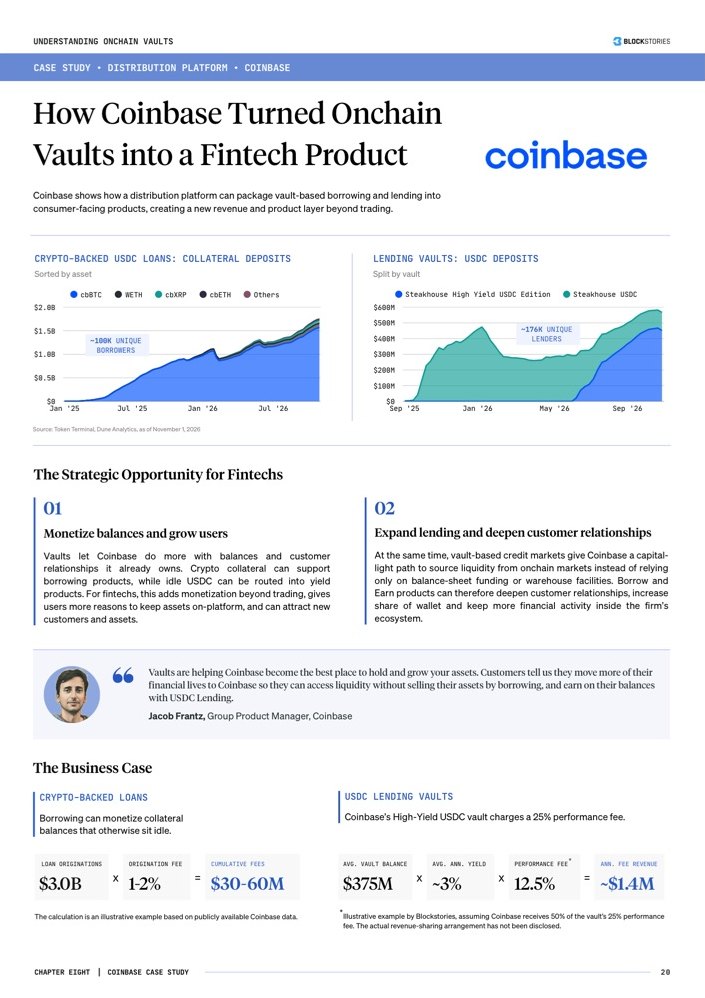
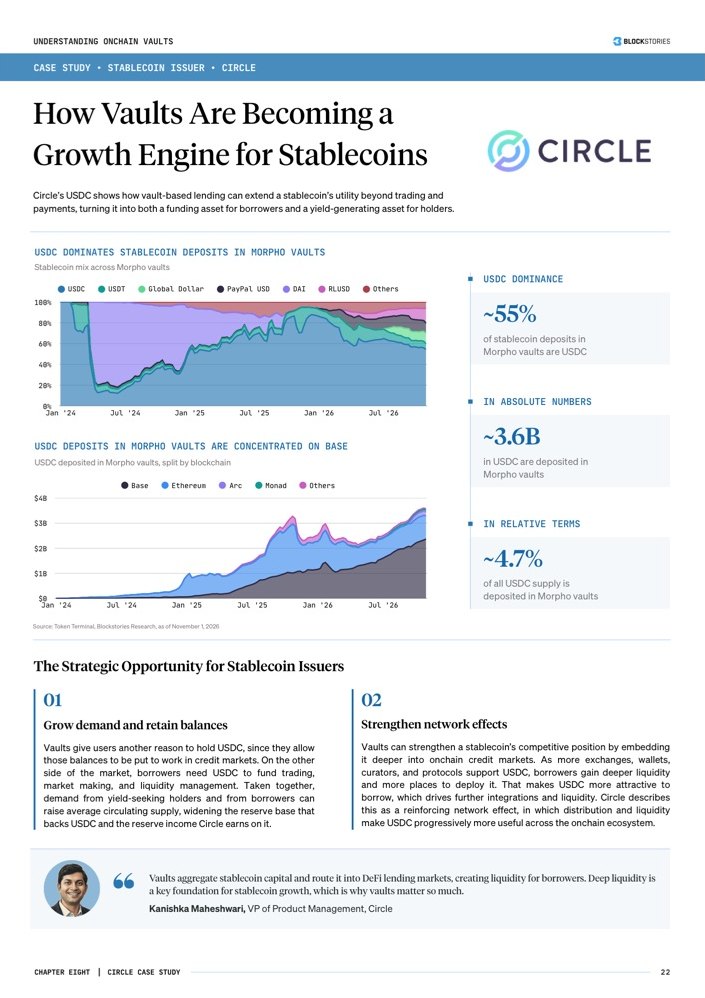
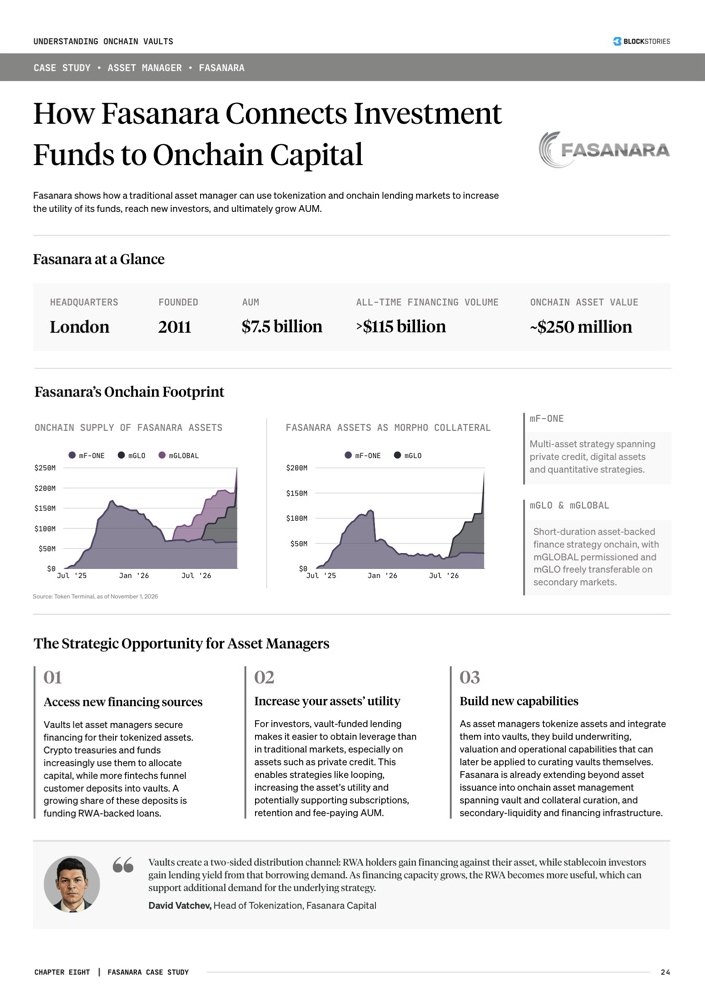
How three companies put vaults to work

Cover of Understanding Onchain Vaults

Get the full report

* By submitting your email, you consent to receive research and marketing communications from Blockstories.See our privacy policy.